
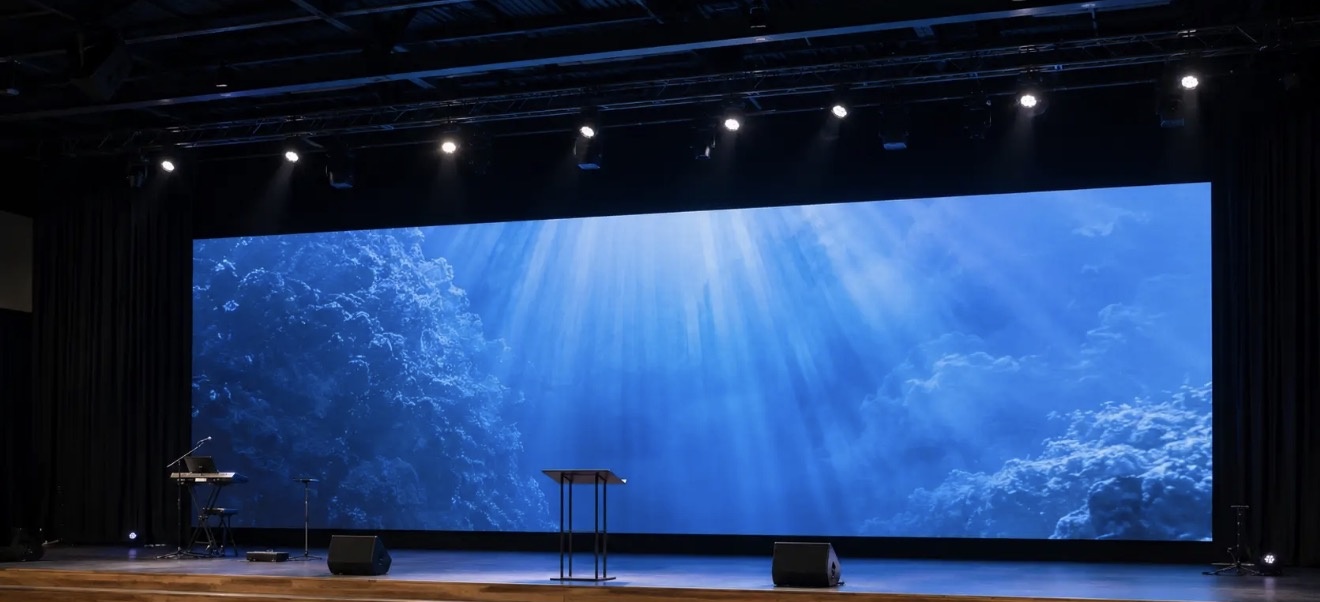
An LED wall can carry lyrics, sermon notes, camera feeds, menus and visuals in one bright, seamless surface. Divine Audio Solutions designs and installs permanent LED displays for houses of worship, nightclubs, restaurants and music venues, sized and specified for the room and the way it is used.
Where permanent LED displays fit
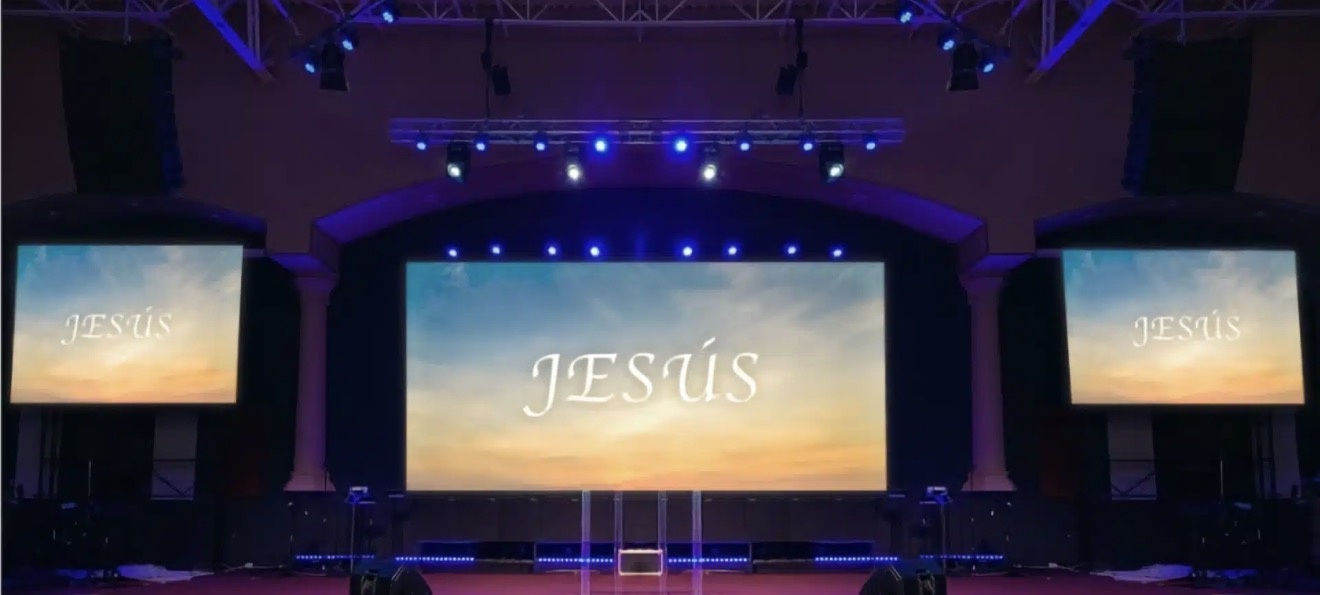
Houses of worship. Stage-backdrop walls and side screens for lyrics, scripture and image magnification, readable from the back row and clean on camera.
Nightclubs. Walls behind the DJ booth and around the dance floor driven with visuals that match the music.
Restaurants and bars. Menu boards, feature walls and sports or entertainment content on displays that stay bright in daylight.
Live music venues. Stage backdrops and wayfinding or marquee displays.
Indoor fine-pitch vs. outdoor
Indoor walls use small pixel pitches for close viewing and moderate brightness. Outdoor displays use weather-rated cabinets, higher brightness to stand up to direct sun, and larger pitches because people view them from farther away.
Pixel pitch and viewing distance
Pixel pitch is the distance between pixel centers, in millimeters. Smaller pitch means higher resolution and a higher cost per square foot. A common rule of thumb is that the closest comfortable viewing distance in feet is roughly 8 to 10 times the pitch in millimeters (for example, around 25 to 30 feet for a 3 mm panel). We pick pitch from your actual seating distances and the content you plan to show.
Brightness and ambient light
Brightness is measured in nits (candelas per square meter). Indoor walls usually run in the hundreds of nits up to roughly 1,500, often dimmed further for comfort; outdoor and sun-facing displays commonly need several thousand nits. Too much brightness in a dark room causes glare and washes out cameras, so we plan for adjustable or scheduled brightness.
Refresh rate and scan rate for cameras
If the wall will be filmed or streamed, refresh rate matters. Low refresh rates and certain scan configurations can show flicker or rolling bands on camera. We specify panels with high refresh rates and check them with your cameras during commissioning.
Processing, signals and playback
An LED wall is fed by a video processor (sometimes with a scaler) that maps the incoming signal onto the exact pixel layout of the cabinets and handles color, brightness and multiple inputs. Sources reach it over HDMI, SDI (useful for long runs from cameras and switchers) or network video such as NDI. Content can come from a presentation computer, a media player on a schedule, a video switcher or a live camera feed. We design the routing so the right source reaches the wall without a tangle of adapters.
Mounting and serviceability
Walls mount on engineered frames fixed to the wall or structure, or are hung from rated points. We plan for service access: front-serviceable modules for walls mounted flush, or a rear service gap where space allows. We keep spare modules from the same production batch so replacements match in color.
Power and cooling
LED walls draw significant power at full white and much less on typical content. We size circuits for maximum draw and plan heat removal, since processors and cabinets warm the space.
Signage rules
Outdoor and street-facing displays may be regulated by local sign codes covering size, brightness, motion and hours.
Our process
- Consult. Goals, content, seating and viewing distances, budget range and timeline.
- Site walk. Measurements, ambient light check, structure, power, camera positions and signal paths.
- Design you approve. Wall size and pitch, cabinet layout, processor and signal plan, mounting and power. Nothing is ordered until you sign off.
- Install and calibrate. Mounting, cabling, processor mapping, brightness and color calibration, camera check.
- Training. Hands-on training on switching sources, playback and brightness.
- Service. Module replacement, recalibration and support.
Frequently asked questions
How do we choose the right pixel pitch?
From the closest viewing distance and the content. Text and fine detail at close range need a smaller pitch; distant viewing allows a larger one.
Will the wall flicker on our livestream?
Not if refresh rate and camera settings are matched. We specify high-refresh panels and test with your cameras.
Is an LED wall better than projection?
In bright rooms, usually. LED holds contrast under stage and daylight. Projection can cost less in dark rooms. We compare both for your space.
Can we show different content on parts of the wall?
Yes. Most processors support multiple windows or inputs on one wall.
Do you supply screens for one-time gatherings?
No. We design, install and service permanent displays only.
Ready to see the difference?
Tell us about your room and we will schedule a visit.